From Entrance Preparation
Subject-Wise Preparation
What should I actually study?
Foundation / 14 min
After this reading, you can map each exam subject to the ability it tests and build a weekly practice loop across them.
Subject-wise preparation can become an exhausting catalogue: perspective, logic, creativity, art movements, materials, manufacturing and general awareness all seem to demand separate study. A better plan asks what each subject enables you to do. The aim is not to collect facts evenly; it is to observe, reason, generate, communicate and make decisions under the conditions of the assessment.
Exam formats and weightings change. The current official instructions for the institution and year you are applying to are the authority; a preparation article is only a framework. For example, CEED 2027 describes Part A as evaluating visual and spatial ability, environmental and social awareness, analytical and logical reasoning, language, observation and design sensitivity, while Part B tests design, drawing and writing. UCEED 2027, the undergraduate route, uses a similar two-part structure: a computer-based Part A and a Part B of two questions testing drawing skills and design aptitude. Other institutions can organize or evaluate these abilities differently.
| Study area | Capability | Evidence in a response |
|---|---|---|
| Observation and sketching | Notice form, proportion, use and context; make ideas visible | Clear views, relevant detail, people in scale and readable sequences |
| Analytical and spatial reasoning | Represent relationships, test patterns and manipulate forms mentally | A correct method, efficient elimination and a checked answer |
| Visual perception | Recognize hierarchy, figure–ground, transformation, balance and anomaly | Accurate comparison and an explanation of the visual rule |
| Creative ability | Generate alternatives and choose one that is both distinctive and appropriate | Meaningfully different ideas followed by a reasoned selection |
| Art and design context | Read visual language in relation to technology, culture and purpose | Recognition supported by characteristics rather than memorized labels alone |
| Materials and manufacturing | Connect desired behavior to material properties and feasible processes | A choice that considers performance, making, cost, use and afterlife |
Use this map for your route
Not every route asks for every subject in equal measure. Start from the paper you will sit, study what it leans on first and let the rest wait. The table is a starting point drawn from each exam’s reading; the current official brochure is still the authority.
| Route | What the assessment leans on | Study first |
|---|---|---|
| UCEED (B.Des, after Class 12) | A computer-based Part A of reasoning, visualisation and awareness; a Part B of drawing and design aptitude | Spatial and analytical reasoning, observation and sketching |
| NID DAT (B.Des, after Class 12) | A paper-and-pencil Prelims for shortlisting; a Mains of studio and in-person tests that alone decides merit | Drawing and ideas on paper, then making with materials and explaining your choices |
| NIFT (B.Des, after Class 12) | A general paper of English, numbers, reasoning and current affairs; a creative paper carrying half the rank; a Situation Test with materials | Drawing, colour and ideas, with steady practice in English, numbers and current affairs |
| CEED (M.Des, after a degree) | A Part A of reasoning, perception and awareness; a Part B of design, drawing and writing | Reasoning and visual perception, then sketching and writing a design response |
English, numbers and current affairs need the same loop as drawing, only shorter. Do a small timed set each week, log every error by type and read a newspaper most days, noting a few items in your own words. Materials and manufacturing in depth, and art history beyond recognising a movement, can follow once the subjects your paper leans on are steady.
Sketch to think and communicate
Sketching in design is not one universal standard of artistry. It can externalize a half-formed idea, compare alternatives, explain an object, map an interface or show a person using a proposal. The required fidelity depends on the discipline, the decision and the assessment. A quick wireframe and a rendered product view are both sketches, but they answer different questions.
Treat speed, clarity and visual finish as separate variables. Fast drawing helps when many options must be explored; construction and perspective help when an object must be understood; finish helps when presentation quality is itself relevant. A polished sketch that hides how something works is not automatically stronger than a rough sequence that communicates the interaction.
| Task | What the drawing must communicate | Focused practice |
|---|---|---|
| Object and form | Volume, proportion, construction and important details | Draw one object from front, side, top and a three-quarter view; compare alignment across views |
| Interface and flow | Hierarchy, states, navigation and sequence | Create low-fidelity screens, then annotate the action connecting each state |
| Person and use | Posture, grip, scale, reach and the relationship between user and object | Draw simple figures performing one real task before adding surface detail |
| Storyboard | Situation, change over time, cause and outcome | Use four to six panels with consistent actors, framing, arrows and short captions |
Practice with the tools and paper permitted by the current examination. Do not assume that an eraser, ruler, medium or rendering technique is allowed—or that exceptional illustration alone will earn a strong result. Check official instructions, then rehearse with those exact constraints.
- Choose one communication goal: form, use, sequence, mechanism or atmosphere.
- Make a slow observational study to understand construction and proportion.
- Repeat it within a short time limit while preserving the essential information.
- Ask another person what they understand without explaining the drawing first.
- Revise the weakest signal rather than redrawing everything for neatness.
Reasoning is a set of strategies, not an IQ verdict
Aptitude questions are often reduced to IQ and processing speed, but that framing is too narrow. Design-aptitude assessments may combine visual and spatial manipulation, pattern recognition, numerical relationships, language, observation, environmental or social awareness and analytical reasoning. Performance also depends on understanding the task, selecting a representation, recognizing familiar structures, managing time and checking errors.
Practice cannot guarantee a particular result, but it can improve familiarity, strategy, accuracy and pacing. The goal is not to memorize answers. It is to recognize the family of a problem early enough to choose an efficient method instead of using blind trial and error.
| Move | Question | Common failure |
|---|---|---|
| Classify | Is this primarily spatial, numerical, verbal, logical or observational? | Beginning calculations before understanding the relationship |
| Represent | Would a diagram, table, sequence, grid or elimination list reduce the mental load? | Holding every condition in memory |
| Find invariants | What remains constant as position, orientation or value changes? | Responding to surface appearance rather than structure |
| Test | Does the proposed rule explain every given case? | Stopping after one confirming example |
| Eliminate | Which options violate a condition immediately? | Fully solving choices that can be rejected cheaply |
| Check | Did I answer the exact question, use the right unit and respect all constraints? | Losing marks after otherwise correct reasoning |
Keep an error log with four labels: concept, representation, execution and time. A concept error needs study; a representation error needs a better diagram or method; an execution error needs careful checking; a time error needs pacing and prioritization. Repeating a full paper without this diagnosis can reproduce the same weakness.
Train visual perception deliberately
Visual-perception tasks ask you to notice how elements relate: which shape completes a transformation, how a solid rotates, which view matches an object, where figure separates from ground or which element violates a pattern. The transferable skill is disciplined comparison.
- Separate the variables: count, orientation, size, position, overlap, tone and negative space.
- Describe the transformation in words or arrows before selecting an option.
- Use real objects, folded paper or simple blocks to verify spatial assumptions during untimed study.
- Study why distractors look plausible; they often reveal the rule you are applying incorrectly.
- Alternate recognition exercises with drawing from memory so seeing and reconstructing reinforce each other.
Creativity needs divergence and judgment
A useful creative response is not merely unusual. It must also fit the user, context and constraints. Divergent thinking helps produce possibilities; convergent judgment helps compare them and commit. Entrance tasks may reward evidence of both, even when they do not use those terms.
| Lens | Question | Practice move |
|---|---|---|
| Fluency | Did I produce enough options to avoid accepting the first idea? | Set a short quantity target before evaluating |
| Flexibility | Do the options represent different principles or only cosmetic variations? | Group ideas by mechanism, user behavior or system model |
| Originality | What is less expected about this response? | Use analogy, reversal or a random stimulus to escape the default |
| Elaboration | Is the chosen idea developed enough to understand and test? | Add sequence, scale, material, edge cases and a reason for each feature |
These are lenses for practice, not a claim that every entrance examination uses a Torrance-style scoring system. Creativity research uses several different instruments: divergent-thinking tasks examine idea production, associative tasks examine connections and expert-judgment approaches evaluate products in context. No single test captures the whole of creative practice.
| Method | Prompt | Best moment to use it |
|---|---|---|
| Mind map | What people, activities, constraints and related concepts surround the problem? | Opening the territory |
| SCAMPER | What can be substituted, combined, adapted, modified, repurposed, eliminated or reversed? | Transforming a familiar idea |
| Analogy | Where else does a similar relationship or behavior occur? | Finding a new organizing principle |
| Reverse thinking | How would I make the situation worse, then reverse those conditions? | Exposing hidden assumptions |
| Constraint | What changes if cost, material, time, space or ability is sharply limited? | Forcing priorities |
| Random stimulus | What property of this unrelated word, image or object could transfer? | Breaking repetition |
| Role-play | What happens before, during and after use for a specific person? | Developing interactions and services |
| Incubation and return | What appears after attention moves elsewhere, and does it survive review? | When effort has become circular |
Study art history as changes in visual logic
A list of artists and dates is fragile knowledge. Build a timeline around changes in purpose, representation, technology and society. For each movement, learn a small number of distinguishing characteristics, place them in context and practise recognizing those characteristics in an unfamiliar work.
| Period | Movements represented | Visual or contextual shift to notice |
|---|---|---|
| Early image-making | Prehistoric and ancient traditions | Images serve ritual, record, power, belief and everyday life through changing materials and conventions |
| Medieval to Renaissance | Medieval art and Renaissance | Symbolic hierarchy gives way, unevenly, to renewed naturalism, perspective and human-centered inquiry |
| Drama and ornament | Baroque and Rococo | Movement, theatrical contrast and persuasion develop into lighter, intimate ornament |
| Reason, emotion and observation | Neoclassicism, Romanticism and Realism | Classical order, subjective intensity and attention to contemporary life offer competing responses to social change |
| Modern perception | Impressionism, Post-Impressionism, Symbolism and Art Nouveau | Light, color, interior experience and organic line loosen inherited representation |
| Early avant-gardes | Fauvism, Cubism, Futurism and Expressionism | Color, fractured viewpoint, speed and emotion challenge naturalistic depiction |
| Idea and unconscious | Dada and Surrealism | Chance, readymades, absurdity and dream imagery question what art can be |
| Postwar to contemporary | Abstract Expressionism, Pop Art, Minimalism, Conceptual Art, Postmodernism and contemporary practices | Attention moves among gesture, mass culture, material, systems, ideas, identity and global contexts |
Use a four-part study card: movement, identifying characteristics, historical context and one representative work you can analyze. Then compare adjacent movements. The contrast between two approaches is easier to retrieve—and more useful for visual reasoning—than an isolated paragraph.
This map follows the Western sequence, and it is not the whole picture. Indian traditions belong in the same study: miniature painting, temple and Mughal architecture, crafts such as block printing, handloom weaving and pottery, and modern Indian art from the Bengal School onward. Study them the same way, with a few distinguishing characteristics, the context that shaped them and one example you can analyse.
Materials turn ideas into consequences
Materials and manufacturing can feel like the unglamorous side of design, but they determine weight, strength, flexibility, surface, tolerances, maintenance, cost, production scale and disposal. A form that ignores how matter behaves is only a picture of a product.
| Family | Typical tendencies | Examples and common processes |
|---|---|---|
| Metals | Often strong, conductive, ductile or formable; properties vary widely by alloy and treatment | Steel, aluminium and copper; casting, forming and machining |
| Polymers | Often lightweight, chemically resistant and capable of complex molded forms | PE, PP and PVC; injection, blow or compression molding and some additive processes |
| Ceramics | Often hard, heat-resistant and brittle | Porcelain, alumina and silicon carbide; forming, firing, sintering and specialized casting |
| Composites | Combine constituents to tailor properties such as stiffness, weight or toughness | Concrete, glass-fibre and carbon-fibre systems; lay-up, molding and forming |
| Natural materials | Properties depend strongly on growth, fibre direction, moisture and processing | Wood, cotton and leather; cutting, forming, joining and textile processes |
| Recycled or bio-derived feedstocks | May reduce some impacts but performance and end-of-life depend on the full system | Recycled metals, paper and polymers; reprocessing, forming, molding or fibre conversion |
| Process family | Transformation | Questions a designer should ask |
|---|---|---|
| Casting | A liquid or flowable material takes the shape of a mold and solidifies | Where are draft, parting, shrinkage, wall thickness and finishing relevant? |
| Machining | Material is removed by cutting, drilling, milling or turning | Can the tool reach the feature, what is the tolerance and how much material becomes waste? |
| Forming | Force reshapes material without deliberately removing it | What direction, thickness, bend radius, spring-back or tooling does the form require? |
| Molding | A pliable material is shaped in a mold | Which volume, geometry, undercuts, cycle time and production quantity justify the tooling? |
| Additive manufacturing | A part is built layer by layer from digital geometry | What orientation, support, anisotropy, surface finish and post-processing matter? |
| Textile processing | Fibres become surfaces or structures through weaving, knitting, bonding, dyeing or finishing | How will stretch, drape, seam, comfort, wear and care affect use? |
| Recycling | Discarded material is collected, separated and reprocessed | Can materials be identified and separated, and what quality is retained after processing? |
Words such as recycled, natural or biodegradable do not prove that a choice is sustainable. Ask where the material comes from, how much is used, what energy and chemistry processing needs, how long the product lasts, whether it can be repaired or separated and what end-of-life route actually exists in the intended context.
Use Ashby charts to compare trade-offs
Material-selection charts plot one property against another—often on logarithmic axes—and show regions occupied by material classes. A strength-versus-density chart, for example, helps compare candidates when low mass and high strength matter together. The chart narrows a field; it does not make the final choice, because geometry, processing, cost, availability, safety and environmental conditions remain part of the decision.
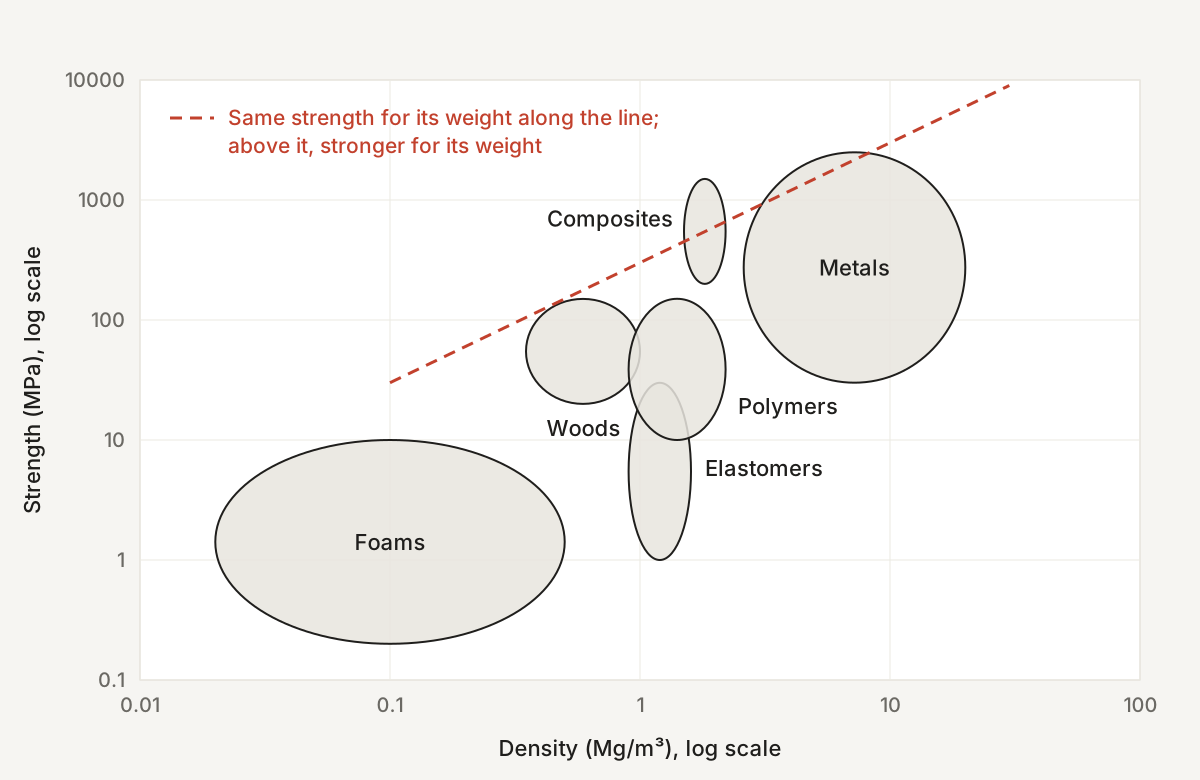
Read it for a part that must be strong and light, such as a bicycle frame. Along the dashed line, materials are equally strong for their weight; above it, stronger. Composites and the strongest metals reach the line, woods come close, and foams and elastomers fall far below it. That narrows the field to two or three classes; the list below takes the decision from there.
- Translate the design goal into requirements: function, constraints, objective and free variables.
- Choose properties that represent the important trade-off, such as stiffness and density.
- Read both axes and units, noting whether the scales are logarithmic.
- Identify plausible material regions and compare candidates rather than selecting one point immediately.
- Return to processing, cost, joining, finish, availability and life-cycle questions before committing.
Build a weekly loop across subjects
Do not study every subject every day. Use a cycle that alternates focused drills, integrated prompts and review. A single design task can combine observation, sketching, creativity, materials and explanation; reasoning sets can be reviewed separately for method and speed.
| Session | Example focus | Output to retain |
|---|---|---|
| Skill drill | Perspective, people, spatial transformation, material joints or visual comparison | A dated sheet with one narrow criterion |
| Knowledge study | One art period, material family or manufacturing process | A comparison card made in your own words |
| Integrated prompt | A timed redesign, storyboard, object visualization or reasoning set | A complete response under recorded conditions |
| Critique | Relevance, alternatives, clarity, feasibility and completion | Specific feedback and the decision it changed |
| Revision | Repeat the weakest part without copying the entire answer | Before-and-after evidence |
Measure preparation through decisions you can now make, errors you can now diagnose and ideas you can now communicate. Hours matter only when they leave evidence of learning.
Takeaway