From Entrance Preparation
Design Aptitude Test Preparation
What if the question is unfamiliar?
Intermediate / 12 min
After this reading, you can decode an unfamiliar prompt, plan your time and review your response against the brief.
Understand what the assessment is looking for
Design institutions may use written aptitude exercises, practical studio tests or other evaluations to understand whether an applicant is ready for a particular programme. The exact format, materials and scoring vary, so always check the institution’s current instructions. Across formats, the useful preparation is broader than memorising question types.
How the main tests are structured
Formats change from year to year, but knowing the current structure helps you plan practice around the real conditions. The 2027 cycle, for example, is organised as follows.
| Test | First stage | Drawing, studio or later stage |
|---|---|---|
| UCEED 2027 | One three-hour paper of 300 marks. Part A (two hours, 200 marks) is computer-based: 14 numerical-answer, 15 multiple-select and 28 multiple-choice questions | Part B (one hour, 100 marks): two questions testing drawing skills and design aptitude, answered in a booklet |
| CEED 2027 | Part A (one hour, 150 marks) is computer-based: 8 numerical-answer, 10 multiple-select and 26 multiple-choice questions. Part A marks are used to shortlist | Part B (two hours, 100 marks): five questions on sketching, creativity, form sensitivity, visual sensitivity and problem identification, 20 marks each |
| NID DAT 2027 (undergraduate) | DAT Prelims, held on 20 December 2026. The score is used only to shortlist candidates for the Mains | DAT Mains: a Studio Sensitivity Test and an In-Person Sensitivity Test |
| NIFT entrance 2027 (B.Des) | A General Ability Test and a Creative Ability Test | Shortlisted candidates take a Situation Test |
The computer-based sections reward accuracy as well as speed. In both UCEED and CEED, wrong answers to multiple-choice and multiple-select questions lose marks, while numerical-answer questions carry no negative marking. The drawing and studio stages are evaluated by people, which is where the abilities below become visible.
A design aptitude task creates a situation with incomplete information and limited time, then asks you to make your thinking visible. The evaluator may be looking at how you observe, interpret users and context, generate alternatives, work with constraints, communicate spatial ideas and learn from materials—not only whether the final drawing looks polished.
| Ability | What it looks like in a response | How to practise |
|---|---|---|
| Observation | Relevant details about people, objects and context | Draw from life, annotate use and notice proportions or failure points |
| Visualisation | Forms, spaces and sequences that others can understand | Practise perspective, exploded views, storyboards and scale |
| Problem framing | A clear account of the need before a solution appears | Restate prompts and identify users, situations and desired change |
| Ideation | Several meaningfully different possibilities | Generate variations before choosing and avoid cosmetic-only changes |
| Design judgment | A choice connected to constraints and trade-offs | Compare options and explain why one direction fits better |
| Material intelligence | A model whose form and joints suit the material | Cut, fold, join and reinforce common studio materials |
| Communication | A response that can be understood without narration | Use hierarchy, labels, arrows, views and concise notes |
DAT and written design tasks
A Design Aptitude Test may combine sketching, visualisation, product or system concepts, visual communication, creative transformation and knowledge of materials, manufacturing, environment or everyday objects. A strong response connects these abilities: a novel idea that ignores the user is incomplete, while a sensible idea that cannot be communicated remains hard to evaluate.
Studio and practical tasks
A studio test moves the same reasoning into physical work. You may be asked to build a three-dimensional form or product concept from paper, cardboard, clay, foam or other supplied materials. The result reveals planning, dexterity, construction logic, material handling and how you respond when an idea meets physical resistance.
Recognise common prompt families
Question wording changes, but many tasks can be understood through a small set of prompt structures. Learn to identify what each structure is testing rather than rehearsing one visual answer.
| Prompt pattern | Examples | Primary signal |
|---|---|---|
| Design for a user | A lunch box for a child; a blender for an older adult | Whether user needs change the design |
| Design for a situation | Support a child crossing a road; help someone work from home | Whether context, behaviour and risk are understood |
| Design with a constraint | A fan that is easy to clean; footwear usable with one hand | Whether a specification becomes a meaningful feature |
| Draw from observation or memory | Sketch a vehicle, tool or everyday product | Proportion, construction, detail and visualisation |
| Generate variations | Draw several chairs, bottles or phone covers | Range, fluency and difference between ideas |
| Find alternative uses | Transform a cup, clothes peg or pair of scissors | Ideation, analogy and visual explanation |
| Make with supplied materials | Create a desk organiser from cardboard or a lamp from paper | Material judgment, structure and model-making |
| Redesign or replace | Improve packaging, a tool handle, shoe soles or a public bench | Diagnosis, improvement and trade-offs |
| Compose from abstract elements | Create a product or narrative from circles, triangles and squares | Abstraction, composition and storytelling |
Design something
When the prompt begins with ‘design,’ resist drawing the first familiar product that comes to mind. Identify the user, task, setting and required property first. A laptop case for a visually impaired person, for example, is not solved by adding a decorative texture. Ask how the case is located, oriented, opened, secured and distinguished through touch.
- Name the person or group and avoid treating them as a stereotype.
- Describe the activity before, during and after use.
- Identify the most important difficulty or opportunity in that sequence.
- Turn the stated constraint into criteria the design can be checked against.
- Generate alternatives that change the interaction, form or system—not only appearance.
Redesign something
A redesign question starts with diagnosis. Explain what is not working, for whom and under which condition before proposing a change. When replacing a disposable bottle, redesigning an oil package or improving a farm-tool handle, consider use, safety, maintenance, material, manufacture, cost and disposal at the depth the prompt allows.
Existing situation → Specific failure
         ↓
People + context + constraints
         ↓
Alternatives → Chosen change → Expected improvement
Decode the prompt before making
A common failure is not lack of creativity but answering a different question. Aptitude prompts may be intentionally dense or indirect because interpretation is part of the task. Rewrite the problem in your own words and separate what is fixed from what you are free to decide.
A worked example
Practice prompt, written for this reading rather than taken from a past paper: ‘Design a table fan for a shared hostel room that one person can clean completely in under five minutes, without tools. Show three concepts, develop one in two views and label how it opens for cleaning. Time: 60 minutes.’ Decode it yourself first, in the worksheet below, and then compare your breakdown with the one that follows.
Interactive worksheet
Decode a practice prompt
Your saved note stays on this device.
What exactly must be submitted?
Who is the response for, and what matters to them?
Where, when and during which activity will it be used?
Which requirements, materials and limits are fixed?
What visible evidence would show that the response works?
Add a response to create your note.
Decode the prompt above before reading on, then use this on a past paper. Use it before sketching or model-making. Save the breakdown on this device or copy it into your practice notes.
One possible breakdown of the same prompt:
| Ask | Breakdown |
|---|---|
| Deliverable | Three concept sketches, one concept developed in two views, and labels showing how it opens for cleaning, all within 60 minutes |
| User | Students who share the room and take turns cleaning; they may have no tools, no instructions and little patience for the chore |
| Situation | Dust builds up on the blades and guard over weeks; the fan is cleaned on a desk or the floor, and the blades can only be reached once something opens |
| Constraints | One person, under five minutes, no tools, and it must still work safely as a fan: a guard that protects fingers, a stable base and unblocked airflow |
| Success | A reviewer can follow, from the drawings alone, where the fan opens, what comes off, how it is held while cleaning and why it stays safe in use |
Notice what the breakdown has already decided. ‘Easy to clean’ has become three checks—one person, five minutes, no tools—and the three concepts can now differ in how the fan opens and what comes apart, rather than in decoration. A response that restyles the same fan three times has not answered the prompt, however well it is drawn.
One response that follows from this breakdown. The three concepts are described; the developed one is drawn below, as it might look on the answer sheet:
- Concept 1, a hinged guard: the front grille swings open like a door from a latch at the top, and the blade pulls straight off its shaft.
- Concept 2, a split body: a twist ring releases the front half of the housing, so the guard and blade come away together and can be rinsed.
- Concept 3, a lift-out mesh: the blades sit behind a fine mesh that lifts out as one sheet, and the smooth housing behind it wipes clean in one pass.
- The developed concept, the twist ring, in front and side views: arrows show the quarter turn, and labels name the ring, the parts that come away and where one hand holds the base while the other turns.
- The last few minutes went to checking every label against the Success row of the breakdown.
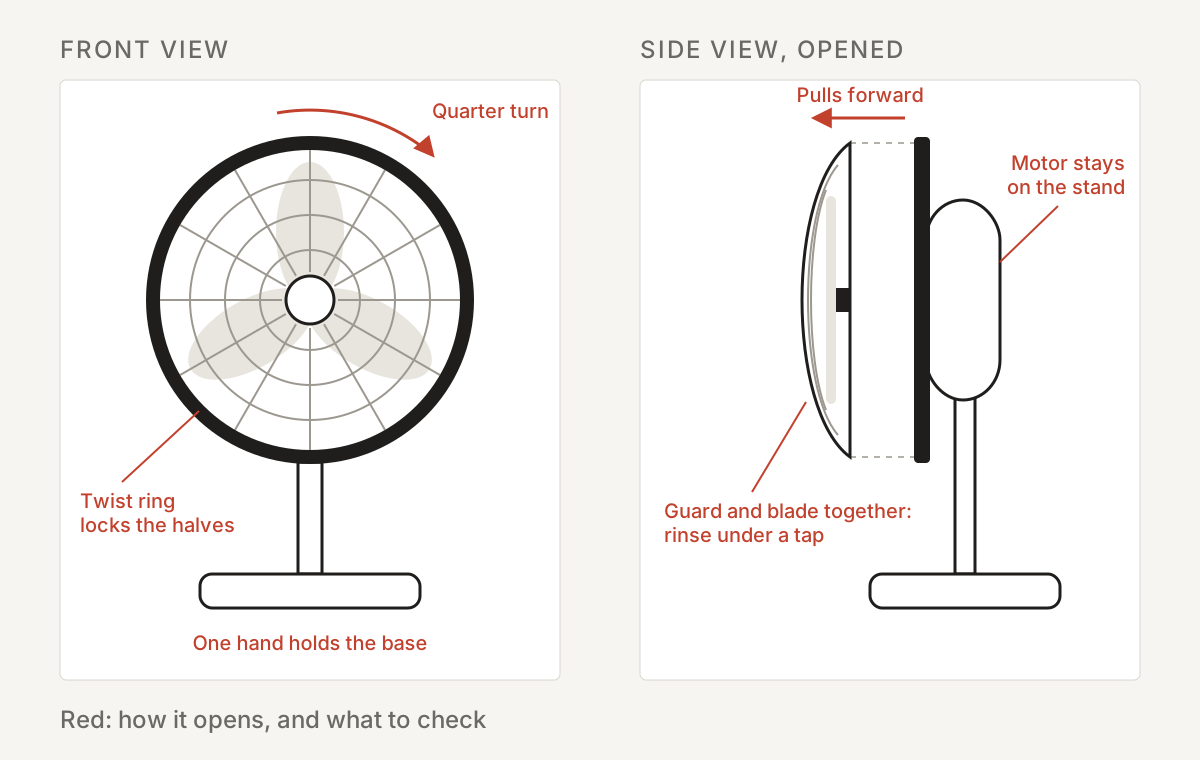
Why develop the twist ring? Against the breakdown, it is the only concept that passes every check at once. The hinged guard opens easily, but its latch is one more part that must stay shut while the blades turn. The lift-out mesh is the quickest to remove, but the blades stay fixed on the fan, so they are wiped in place rather than taken off and rinsed. The twist ring frees the guard and blade in one movement, needs no tools and closes into a sealed guard, so it answers both cleaning and safety.
The drawing shows how the mechanism is meant to work; it does not prove it. Whether the ring turns easily with dusty hands, and whether cleaning really takes under five minutes, are checks for a prototype, not results the sketch has already obtained.
The three concepts differ in how the fan opens, not in how it looks, and each one can be followed without an explanation. Review your own response against your breakdown in the same way:
- Does each concept answer the constraint in a different way?
- Can the opening sequence be followed from the drawings and labels alone?
- Is the developed concept still safe and stable as a fan?
- Do the two views agree in proportion and detail?
- Did the time plan leave a few minutes to check the labels?
Read → Restate → Mark constraints
  ↓
Observe → Generate options → Select
  ↓
Plan → Make → Label → Check → Submit
Plan the time, not only the idea
Timed work needs an execution plan. Reserve time to understand the prompt, explore alternatives, develop the chosen direction and review the submission. For physical tasks, keep additional buffer for cutting, joining, drying, reinforcement or rebuilding a failed connection. A simpler model that remains intact and communicates its idea is stronger than an ambitious form that cannot be completed.
| Phase | Approximate share | Purpose |
|---|---|---|
| Decode | 10% | Restate the task, mark constraints and define success |
| Explore | 20% | Generate alternatives and compare directions |
| Develop | 50% | Draw, model and communicate the selected idea |
| Review | 20% | Complete labels, test clarity, reinforce and correct |
The proportions are a practice model, not a rule for every examination. Adjust them to the deliverable and the institution’s timing. The important habit is deciding how much time remains before execution absorbs the whole session. For example, CEED 2027 Part B allows two hours for five questions—roughly 24 minutes each—while UCEED 2027 Part B allows one hour for two.
Keep the workspace organised
In model-making, organisation protects both time and attention. Group tools, preserve a clear assembly area, make test cuts before committing material and keep offcuts that may become supports. Plan joints before surface details. The model should survive handling long enough for its design idea to be evaluated.
Communicate beyond the final object
Use the response format to show what cannot be inferred from one view. Add arrows for movement, small sequences for use, alternate views for construction, labels for material or scale and brief notes for the decision behind a feature. Communication should support the idea rather than crowd it.
Practise the underlying skills
Repeatedly solving past-style prompts is useful only when the review identifies what needs to improve. Combine timed tasks with focused drills in observation, sketching and material handling. Become familiar with how common practice materials cut, fold, bend, join and fail before a studio test makes that learning expensive.
- Sketch one everyday object from observation, memory and a different viewpoint.
- Generate five alternatives that differ structurally, then explain the strongest two.
- Redesign one component after observing a real difficulty in use.
- Build basic volumes and joints from paper, cardboard, clay or the materials relevant to your test.
- Practise making labels, arrows, sequences and annotations legible under time pressure.
- Review whether each response answers the prompt before judging its visual polish.
Review the attempt like evidence
After each attempt, record where the response weakened. Did you misunderstand the deliverable, assume too much about the user, repeat one idea, ignore a fixed constraint, lose time during execution or fail to make the concept legible? The error pattern should decide the next practice session.
| Check | Question |
|---|---|
| Relevance | Did every major decision respond to the stated user, situation and constraint? |
| Variation | Did I explore genuinely different possibilities before choosing? |
| Reasoning | Can another person understand why this direction was selected? |
| Feasibility | Does the form, mechanism or model behave as claimed? |
| Communication | Are the views, labels and sequence sufficient without verbal explanation? |
| Completion | Did I reserve enough time to review and submit a coherent response? |
Strong design-aptitude preparation does not chase one expected aesthetic. It builds a repeatable way to understand unfamiliar situations, produce alternatives and communicate a reasoned choice within real constraints. That method transfers across written questions, sketches and studio models even when the format changes.
Takeaway